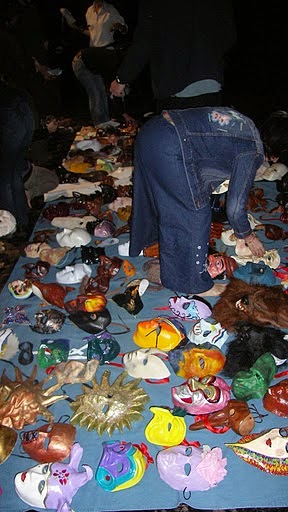
Saturday, June 21, 2014

C’è una maschera per la famiglia
Una per la società
Una per il lavoro
E quando stai solo
resti nessuno. (Luigi Pirandello)

"There is a mask for the family, one for the society, one for the job. But when you're alone no one remains”.

I did not know Pirandello's work so well as to criticize him. I don't know if the last sentence of this aphorism was intentionally negative or not. I do not think that the human personality is like an onion where you remove layer after layer to reach the tasty core.

First in my experience every mask we wear in every moment of our lives is just OUR, OWN mask. Every one of the thousands of masks we build accurately and with passion in our lives, are just a product of ourselves.

Maybe we build each mask with the purpose of hiding something however I believe we wear masks to reveal and show some parts of ourselves.

Social masks are just facets of our mind that we want, decide or just let others see. Sometimes those masks work perfectly together, are consistent one to another, are showing coherently what others see like a specific personality. Sometimes that's not happening, Sometimes what the others see is a magmatic material with no sense and coordination or, worse, they see a different path and characteristics. In that case people can say you are a strange person, maybe eccentric or for sure a little difficult to approach.

But still you can live perfectly well with that. But sometimes you feel that a mask is a little uncomfortable, maybe you sense and feel like with wearing a physical masks, having something heavy on your face that doesn't fit adequately.

Just in this moment, your friends can call for “yourself” maybe in the paradoxical way of “please, be Yourself! Like it would be possible for you to be other than “Yourself”.

So, who and what are your friends calling for? Who or what is that “Yourself” that they seems to know very well? And if that is “yourself” who or what are are the other “selves” that you sometimes pretend to be? A different person? State of mind or what?

I believe that each of us is just all the masks he or she is used to wear with no exception! Myself if it is a real thing, is just a like certain movies, “written, directed, produced … and acted out by this person called “Myself”.

What abilities, skills and tools needs that individual so brave to manage everything? How he or she can rest and relax one moment from this heavy duty? What is the best way to help him or her in that management project?

Tuesday, June 10, 2014

Masks and Music: a strictly relationship!

Masks and music probably were born the same day! When we think on the masks used by our ancestors it is easy to imagine people wearing masks, dancing in trance under the moon!


Music, melodies, songs and refrain are the most powerful emotional triggers mankind ever invented. Music has the quality to evoke the full range of human emotions and sentiments.

This power is connected with memories like when you hear an old melody from your childhood. In that case you can experience an earlier time and some of the emotions connected with the moment from the past.

But music also has a direct connection with your brain, for that we use the music in the movies to accompany some scenes and trigger specific emotions.

Since prehistory and still today native people here in US and around the world are using music to get into a trance. Trance is a different state of mind in what your body feels specific and strong emotions, maybe with hallucinations and physical changes.

Otherwise history of the music is full of good examples of the power of notes, melodies, percussion or songs. The composer of Opera comped to have women faint in theaters. Religion is another field where music is constantly present to facilitate meditation and prayers.

Music therapy is an allied of health professions. In the Bionenergetic therapy (A. Lowen) body exercises are combined with specific music. Biodanza® invented by the Chilean psychiatrist Rolando Toro is a system to work with emotions.

Additionally, we use music to keep us fit by doing “Aerobic dance”, “Jazzercise®”, “Zumba®, “Capoeira” and other disciplines.

Using music with the masks
Music plays an important role working with the masks. Music triggers emotions and facilitates public expression. We use selected songs and music from different traditions and cultures around the word! Classical music and pop/rock music, medieval music and folk music, music from movies and sacred or experimental music.


The choice of music is never casual. Every song, every note is part of the project. There is an intentional choreography with exercises, topics, goals and Masks. Music helps to trigger a specific emotion, or to establish a ritualized boundary. With music we can causes trance, induce relaxation, stimulate meditation or just accompany the deep expression of ourselves. 

Friday, May 30, 2014

Are the Masks a tool for Life Coaching?

Are the Masks a good tool for Life Coaching?

That's an interesting question to answer. I believe so and I want to try to explain why. Most of people think in Mask like something that is cover, hide and conceal parts of our face or body. For analogy, a “social” mask hide part of our real personality. “Take off your mask!” we can say when we think to have caught someone in flagrancy. Meaning we want this person to show us his or her “real self”.

But really, what's that's “real self” or what we intend when we ask someone to be his or her self?

If for sure we wear different “social” masks in our day to day life, the most interesting question is: where that masks are coming from? Who built them?.

I believe that all the masks we wear and inclusive the masks we do not wear, are a human productions, there coming out of our mind, triggered by what we like to call “reality” and whatsoever a “reality” can be.

So we make a lot of masks. One for a partner, one for a parents, one for a children, one for my colleagues, one for my boss or maybe one for my employees, if I am a boss. We build a mask for a good citizen or sometime for a bad one, other for friends and again one also for enemies.

For that I believe a huge part in a life coaching path is to help people to discover all the masks they are wearing and teach some skills about how to be a good director of that sort of strange theatrical company.

For that when people wear a “real artifact mask” over the face, something is happening, some paradoxical stuff are going on. The power of the mask is all here. A Mask over my “social mask” have the power to freed my self (whatsoever that thing Is) in a way that makes my discover other “masks” opportunities to use in life.

An artifact Mask over my “social-built masks” provoke a mind-burn out that literally, can re/start my grown and my change toward that better human been all of us we want to be.

In that sense a weekly group of wearing masks could be like a gym for your mind, a place where maintain your brain cells active and free to explore.


At the same time, a process of life changing could be better coached in some difficult steps with the provocative but sweet power of the Masks.  

Saturday, May 3, 2014

Maks and Poems: love or ...what?

It is difficult to find very nice poems about masks. Most of the poets seems to believe that you wear masks over something like yourself. And that is supposedly your  "real", "deep" and "unique" self. I call hat kind of "simplified" psychology, the "onion" theory, because it seems that humans works like onions. Inside there should be something very deep and sincere and if you start to take off layer over layer, one day you can meet the "core", your real self. I believe our soul is a complex stuff. I believe "core" (if there is one) and layers are built from the same person during the same process. I believe that in our lives we build and wear dozens of different masks, each of them part of ourselves, each of them "us" at the same level of dignity. Our masks, all of them, need to be respected and beloved.


Paul Laurence Dunbar (1872-1906)


      We Wear the Mask
    We wear the mask that grins and lies,
    It hides our cheeks and shades our eyes,—
    This debt we pay to human guile;
    With torn and bleeding hearts we smile,
    And mouth with myriad subtleties.
    Why should the world be over-wise,
    In counting all our tears and sighs?
    Nay, let them only see us, while
            We wear the mask.
    We smile, but, O great Christ, our cries
    To thee from tortured souls arise.
    We sing, but oh the clay is vile
    Beneath our feet, and long the mile;
    But let the world dream otherwise,
            We wear the mask!

The above poem appeared in Dunbar's first professionally published volume, Lyrics of Lowly Life, in 1896 by Dodd, Mead, and Company. It also appeared in the volume Majors and Minors from the previous year. It can be found, for example, in:
- Dunbar, Paul Laurence. The Collected Poetry of Paul Laurence Dunbar. Joanne M. Braxton, ed. Charlottesville: University Press of Virginia, 1993.
- Abcarian, Richard, and Marvin Klotz, eds. Literature: The Human Experience(Shorter Fourth Edition with Essays). New York: St. Martin's Press, 1988. 

Monday, April 21, 2014

Too Little Respect and Too Much Respect

(from Improvisation in Drama, A. Frost & R. Yarrow, PALGRAVE McMillian, pag 165-166)


Too little respect, and the masks will remain lifeless cardboard props; but too much respect - treating the masks as if they were truly the repositories of ancient demons - can stifle creativity altogether. Masks begin work ambushing their wearers. If the atmosphere is good, the work respectful, open, honest and good humored to begin with, the masks will animate the actor (the wearer I would say) rather than the reverse. But it is essential that the work be undertaken with care, so as not stifle the emergence of that new self. [...] What is important here is the emphasis on working with the mask, developing a relationship with it from which the new self can emerge, as a seamless - but never entirely comfortable - "fit" between mask and actor's body (wearer's body)


Ground Rules for Masks Improvisation (Eldredge 1996:42)

1.- Have respect for the Mask.
2.- Work on yourself and for yourself until told to do otherwise. 
3.- Work in silence.
4.- Avoid touching the Mask while wearing it.
5.- Keep the separation clear between your Self and your Mask. (a participant should not speak in her own voice in the mask. The mask does not talk in her voice: it has its own voice). 
6.- When you are told to stop and come out of the mask, you will do so. 

Ultimately, the "trance" or power to change is not in the Mask: it derives from the conjunction of Mask, actor (wearer) and audience. The wearer responds to stimuli both from the mask and the teachers and/or audience: what is involved is a dynamic process of co-creation. 

Thursday, April 10, 2014

Some Words, Several Maks (Rebound)

A night of Poems, Music, Masks and Plays.

Where the power of the Masks came from? Which effect they have on the wearer?
What have in common Persons and Masks?


After some words about that we will wear the masks to play with music and people.

People can wear a Mask and be another one for one night and experiencing live the power of the Masks. 
It   is   a   way   in   some   part   between   art, healing   practice   and   the   therapeutic   power   of art.  
You   can   bring   your   own mask or   wear  one from our collection and move, dance and meet all the other masks. 

Sunday 13th April 5 pm B2 Gallery 711 Saint Helens Avenue, Suite 100 Tacoma, WA. 98402
Join Us, $20, no reservation need.


Wednesday, April 2, 2014

To read about Masks.

Rarely a free download is so interesting, documented and full of triggering stimulus. If you want to know more about masks and philosophy, that's for you!

William Keith Tims: Masks and Sartre's Imaginary: Masked Performance and the Imaging Consciousness.
(move the mouse to see the link)
http://scholarworks.gsu.edu/cgi/viewcontent.cgi?article=1009&context=communication_diss